

On this page
- My role is bigger than the code
- The first design problem was making it finishable
- Five pillars keep the features pointed the same way
- How the project is put together
- The loop is a set of connected systems
- The inventory is the clearest implemented example
- Animation is programming, not just assets
- Input got its own module for a reason
- Editor tooling is part of the build
- The Director and hunter are architecture, not a finished claim
- C++ owns the rules; Blueprint exposes the tuning
- Accessibility has to go in early or not at all
- Production is a system too
- Where it stands
Games
One Man's Poison
A solo-developed third-person survival-horror game in Unreal Engine 5, turning a missing-person case into a focused vertical slice built around investigation, scarcity, and systemic threat.
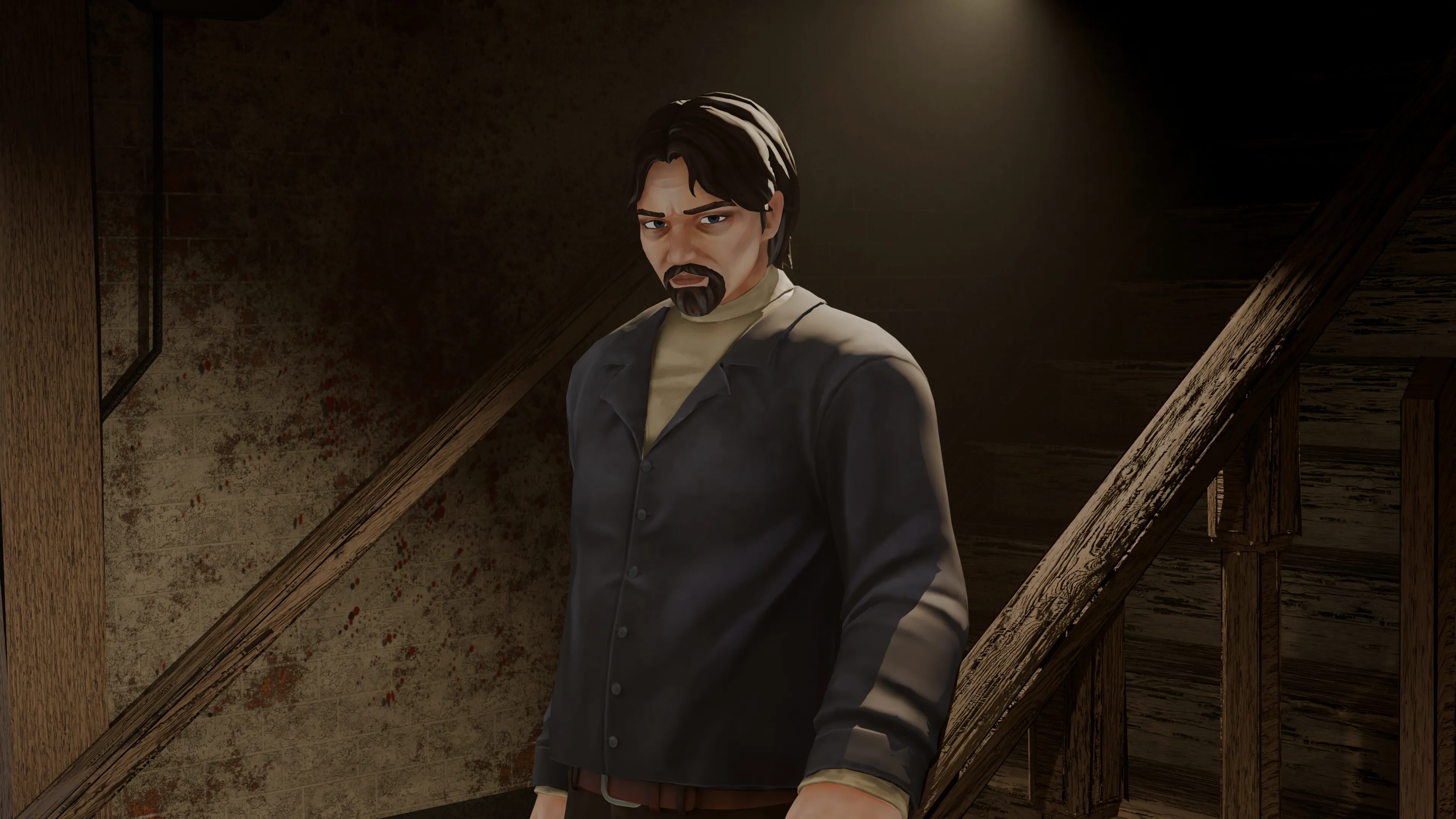
Character model, texture and render by Sherry Chen
One Man’s Poison starts as a missing-person case. Darla Brant hires private detective Jake Dubrowski to find her younger sister, Jess; the trail ends at the supposedly abandoned Fountain Vale Mental Hospital. Jake enters as an investigator and wakes as a prisoner, with the building beginning to disobey its own floor plan around him.
It’s a third-person survival-horror game in active development at CrimsonStrife Games for PC and Linux. It uses the title and certain characters from the short film One Man’s Poison, created by James Cotton through Wolf359 Productions, with permission. The setting, game systems, expanded cast, and the shape of this particular story have been developed for the game.
This is a development case study, not a postmortem for something finished. The useful story is how a large horror-game premise got cut down into something one person can actually build, how the systems hold that experience up, and where the project honestly stands right now.
My role is bigger than the code
I’m the project lead, the designer, and, so far, the only developer. All the gameplay programming in C++ and Blueprint is mine — inventory, interaction, combat, animation, input, and the framework underneath them. I also own the technical architecture, game design, production planning, art direction, platform work, and the public website.
Bringing in specialists is how the work gets done without pretending one person is every discipline. Composition and audio engineering, concept art, casting and voice direction, and character modeling and texturing are collaborative work. My part is to turn the game’s requirements into useful briefs, review work against the art and story bibles, keep credits attached to assets, and schedule each deliverable around what the build can actually use.
The Jake model, texture, and hero render on this page are by Sherry Chen. I led the character design and handled rigging.
The first design problem was making it finishable
The full design covers a campaign, a changing asylum, several kinds of enemies, branching outcomes, a persistent hunter, an adaptive Director, accessibility settings, and more. That’s an exciting list and a terrible first milestone for a team of one.
The working target is now a public vertical slice with a deliberate boundary: introduce Jake, establish Darla’s case, get the player into Fountain Vale, and prove one complete horror-and-puzzle loop. It has to demonstrate the controls, investigation, limited combat, resource pressure, stealth, an anchor room, and the first enemy pressure. It doesn’t have to summarize the whole campaign or spend the story’s biggest reveal just to make a demo look complete.
That boundary changed production from “make the game” into a sequence I can test: grounded opening, asylum entry, safe room, threat area, puzzle, shortcut, return. Every feature now has to earn a place in that loop.
Five pillars keep the features pointed the same way
Detective horror. Jake is working a case, not just looking for an exit. Clues, documents, environmental details, and puzzles need a reason to exist in the world and should reframe what the player thinks happened there.
Scarcity. Ammunition, healing, weapon durability, and inventory space are competing resources. Combat is usually an option, but not always a good one, and the player has to be able to decide on the fly.
Systemic pressure. The long-term goal is a hunter that exists across rooms and rest phases instead of teleporting in for a scripted scare. If the player can learn how it behaves, anticipation does more work than a jump cut.
A world with rules. Fountain Vale can loop, shift, and absorb Jake’s memories, but the instability still needs an internal logic. The premise that the Asylum is playing with reality connects the architecture, interface, save points, hallucinations, and progression instead of excusing arbitrary weirdness.
Readable horror. Tension should come from a challenging decision made with understandable information. Routes need landmarks, puzzles need findable clues, enemies need tells, and accessibility options should remove friction without removing the horror.
How the project is put together
The game builds as three C++ modules rather than one. OneMansPoison holds the
runtime — characters, components, subsystems, AI, animation. OneMansPoisonInput
is separate because input turned out to need its own lifetime and its own
platform-specific data. OneMansPoisonEditor holds everything that only exists
while the editor is open, so none of it can leak into a shipping build.
That split is the reason the rest of this page can be honest about where things stand. Systems that share a module tend to grow into each other; systems that have to talk across a module boundary need an interface, and an interface is something I can change without re-testing the world.
OneMansPoisonInput specifically came about to help detect controller types for proper UI handling, and handling controller type defaults by platform.
The loop is a set of connected systems
The core loop starts in a secure anchor room. The player leaves to investigate, collect evidence and supplies, solve a local problem, and decide whether to avoid or spend resources on a threat. A shortcut or story change opens the way back. The further the player pushes before returning, the more the Director can respond to time, noise, progress, and the resources still in reserve.
That means these aren’t independent portfolio features. Inventory capacity changes exploration. Exploration changes exposure. Noise changes enemy attention. A shortcut changes the value of pressing forward. The save room stores the consequences of all of it.
The inventory is the clearest implemented example
The inventory began with my memory of Resident Evil 4: a “Tetris” case full of irregular shapes. That memory was wrong in a useful way. Its items are rectangles, so a footprint only needs a top-left root slot, width, height, and orientation. Collision becomes a predictable bounds check instead of a library of arbitrary polyomino masks.
The working prototype supports grid placement, rotation, and drag-and-drop. The visual problem was harder: the case should feel like a physical object, but a separate 3D inventory scene and a rendered actor for every item would be too expensive for what the feature needs.
I use Unreal Render Targets and Scene Capture actors to capture the case in two layers. The UI composes them as back-of-case render, interactive slot grid, then front-of-case render. Items remain UI images for now. The result sells depth without spawning and positioning a second set of item actors every time the inventory opens. I wrote more about the tradeoff in What’s in an Inventory?.
The widgets don’t poll the inventory. The component publishes a change event for every operation that can move an item — added, removed, amount changed, moved, resized, equipped, loaded — and the UI subscribes to the ones it cares about. That keeps the grid, the shortcut bar, and the equipment panel consistent without any of them knowing about each other, and it means a system that isn’t UI at all (a save or load for instance) updates the interface for free.
The system is in progress rather than done. Placement and presentation work; item consumption and the full weapon/ammunition connection are the next part of the same feature.
Animation is programming, not just assets
The character runs on a custom anim instance that resolves locomotion, aiming, overlay states, and the transitions between them, backed by a struct library that keeps the tuning data out of the graph. Alongside it are bespoke notifies and notify states — footsteps that pick a surface, camera shake, grounded entry, early blend-out, movement actions, and overlay override — so animation events drive gameplay rather than being decorated by it.
Much of this is likely to be reworked since the move to UE5 from UE4 changed some things, but the current system as implemented does function.
Worth separating from the assets: the animation content currently in the build is placeholder and will be replaced. The systems that play it are not.
Input got its own module for a reason
Controller handling is a separate module carrying per-device data for PlayStation 4 and 5, Xbox One and Series, Switch Pro, Stadia, Steam Controller and Steam Deck, plus Steam Input helpers and identification logic that works out what is actually plugged in. Prompts, remapping, and platform quirks all key off that.
This started as the work needed to support different controller icons and layouts as well as handling controller type defaults by platform. It turned into the layer that makes any future platform a data problem rather than a code problem.
Editor tooling is part of the build
Some of the work that saves the most time never ships. The editor module carries a custom Blueprint compiler node that lowers into two set-by-reference nodes so a common “remember the old value, then set the new one” pattern stops being four nodes of boilerplate, an asset factory and type actions for inventory items, a custom thumbnail renderer so those items are identifiable in the content browser, comment tooling for Blueprint graphs, and a skeleton virtual-bone utility.
Two of those tools grew past the project and became plugins in their own right: an in-house developer toolkit that is still early phases, and Physics Placement Assist, an editor-only plugin that drops and settles selected actors using the editor world’s physics scene, restoring every temporary flag before applying the result so a whole batch reverts with one undo.
The Director and hunter are architecture, not a finished claim
The Director is designed as a central pacing system. Its inputs include player progress, resources, noise, and time in an area; its outputs can influence hunter pressure, encounters, ambience, and music intensity. The hunter side has its world and director subsystems, an anchor-aware AI component, an encounter response component, emergence points, and custom behavior-tree tasks, services, and decorators for the specific decisions a generic tree handles badly.
What isn’t finished is the behavior those parts are meant to add up to: a threat that persists across rooms and rest phases with real pursuit, search, withdrawal and repositioning states, auditory foreshadowing, and a rule for respecting the anchor-room boundary. The contract between the systems is built and tracked, but nothing has been implemented yet. I’d rather show that than pass a design document off as shipped AI.
C++ owns the rules; Blueprint exposes the tuning
The technical direction is a C++ core with a Blueprint layer for values a designer needs to change while playing: thresholds, timings, resource values, and presentation hooks. That split keeps the rules testable and discoverable in code without turning every balance pass into a compile cycle.
The same boundary helps with integrations. FMOD owns the audio authoring workflow, while the game provides state for intensity and events. I’ve also built a reusable Twitch viewer-interaction plugin, integrated CrowdControl, and done the platform work required to run the game on Steam Deck. Stream features stay isolated from the core loop; a community feature should never be able to destabilize the single-player game it’s decorating.
Accessibility has to go in early or not at all
The accessibility plan covers input remapping, toggle-versus-hold actions, text and UI scaling, subtitle and closed-caption support, independent audio levels, motion and flashing reduction, high-contrast and color-vision options, puzzle hints, navigation assistance, and difficulty controls for resources and enemy behavior.
Most of that menu is planned work, not a finished suite. Writing it into the technical design now still matters: a puzzle framework needs an optional hint layer before dozens of puzzles depend on it, important sounds need visual-event hooks before the audio pass is final, and input actions need to be remappable before they spread through one-off Blueprint graphs.
The companion site follows the same principle today with visible content warnings, reduced-motion controls, and privacy choices that leave analytics off until a visitor opts in.
Production is a system too
The game is tracked through linked milestones, issues, discipline documents, asset records, and risk notes in Notion. The design document defines the player experience; the technical document defines how the systems divide; the art and story bibles keep collaborators working from the same canon. Unreal-style asset naming and explicit credit metadata are deliberately boring safeguards against a multi-year project turning into a folder of files only I understand.
Publicly, ompgame.com turns part of that production work into a devlog, press kit, release log, and read-only roadmap. I built that site as its own Astro application and wrote a separate case study for the web platform rather than treating it as a footnote to the game.
Where it stands
One Man’s Poison is in active development, focused on the core loop and the vertical slice. The spatial inventory is playable and still being connected to item use, weapons, and ammunition. The broader Director, hunter, settings, and accessibility work is specified and scheduled around that slice. There’s no release date yet; the current platform target is PC and Linux.
The most useful thing to come out of it so far isn’t a count of systems. It’s a clearer way to decide which one deserves to exist next: prove the missing-person case, the resource decisions, and the trip from safety into danger and back. If a feature doesn’t make that loop stronger, it can wait.